Model | 2X-4C | 2X-8 | 2X-15 | 2X-30A | 2X-70A | Notes | ||
Pump flow rate (L/s) | 4 | 8 | 15 | 30 | 70 | Measure the pressure at the pump inlet using a bench-mounted mercury vacuum gauge. | ||
| Maximum Pressure | Gas Shut-off Station | Pa | ≤6x10⁻² | |||||
| Gas Opening Station | / | ≤6*10⁻¹ | ≤1.33 | |||||
| Maximum Pressure | ≤1 | ≤6x10⁻¹ | Using thermocouples, resistivity meters, and other total pressure gauges. | |||||
Motor Power (kW) | 0.55 | 1.1 | 2.2 | 3 | 5.5 | |||
Temperature Rise (°C) | ≤40 | |||||||
Noise Level (dB(A)) | ≤75 | ≤78 | ≤80 | ≤82 | ≤86 | / | ||
Inlet Diameter (mm) | 25 | 40 | 40 | 65 | 80 | |||
Speed (rpm) | 450 | 320 | 450 | 420 | ||||
Oil Consumption (L) | 1.0 | 2.0 | 2.8 | 2.0 | 4.2 | |||
Dimensions (cm) | 49X31X41 | 79X43X54 | 79X53X54 | 78X50X56 | 91X65X70 | |||
Compatible Solenoid Valve | DDC-JQ25 | DDC-JQ40 | DDC-JQ65 | DDC-JQ80 | ||||
Weight (kg) | 59 | 158 | 202 | 236 | 338 | |||
Cooling Water Flow Rate (L/min) | / | / | / | >1 | >2 | G2/8 threaded hole for imported water pipes | ||
Product Description:
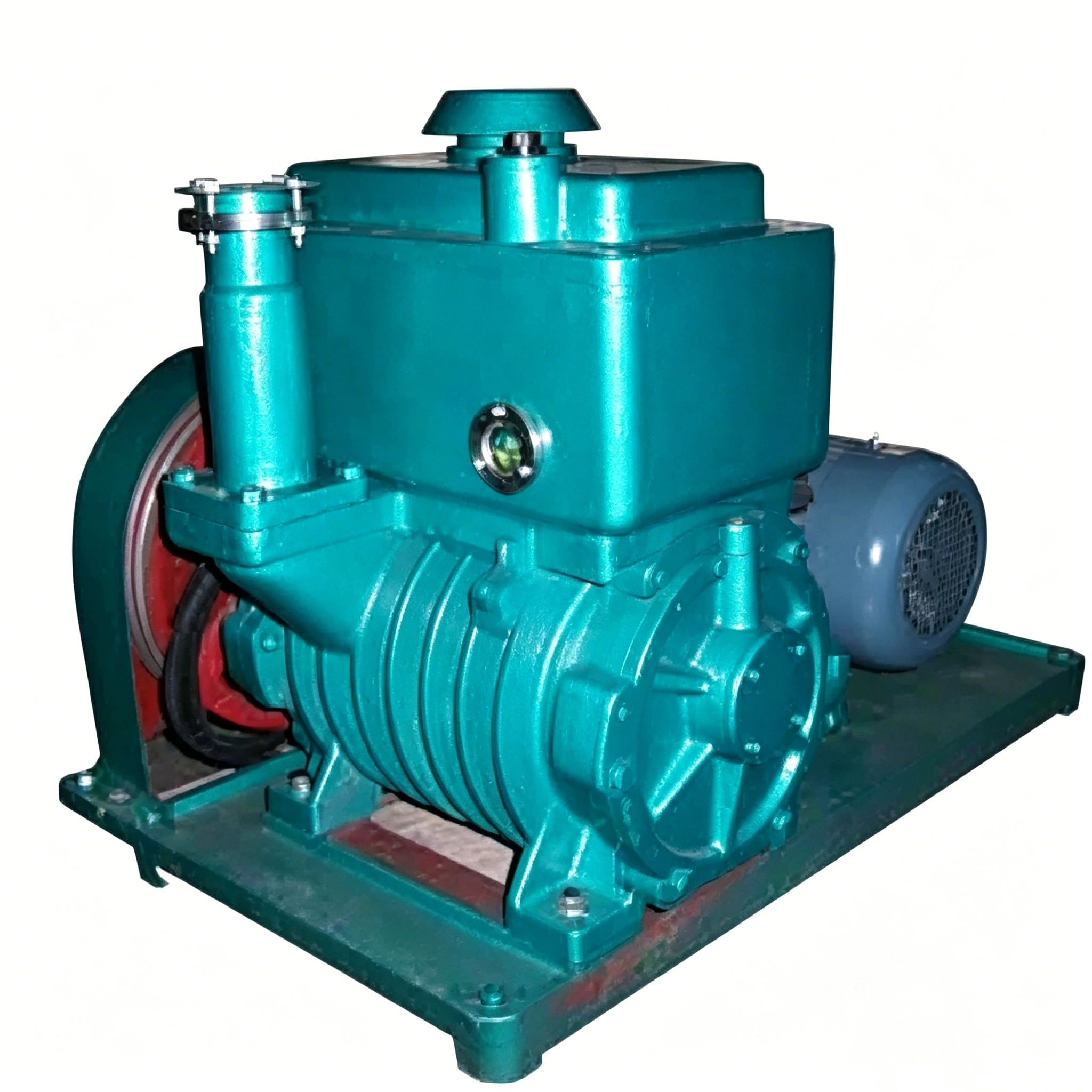
The 2X series vacuum pumps feature a two-stage design. The rotor, equipped with vanes, is mounted eccentrically within a cylindrical stator. When the rotor rotates at high speed, the vanes—which move freely within the rotor slots—are forcefully pushed outward by centrifugal and spring forces, pressing tightly against the inner wall of the stator with their tops. This separates the inlet and outlet ports on the stator. The volume enclosed by the vanes leading to the inlet gradually and periodically expands as the rotor rotates, while the volume leading to the outlet gradually and periodically decreases. Thus, air or mixed gases are first drawn into the high-vacuum stage inlet, then compressed, and finally discharged through its exhaust valve. During operation, when the exhaust pressure is insufficient to open the exhaust valve, the gas compressed in the high-vacuum stage is transferred to the second stage and finally discharged into the atmosphere through the second-stage exhaust valve, thereby creating a vacuum at the pump’s inlet. The exhaust valves are immersed in oil, which circulates within the pump to provide lubrication and sealing.
The pump is equipped with a gas ballast valve. When the gas being evacuated contains a small amount of water vapor, opening the gas ballast valve allows air to be injected into the pump’s exhaust chamber. The vapor is then expelled along with the air, preventing it from condensing into water inside the pump. This prevents the oil from becoming emulsified by the condensed water, thereby extending the service life of the pump oil.
This pump is a fundamental piece of equipment used to evacuate gas from sealed containers to achieve high vacuum. It can be used independently or as a fore-vacuum pump. It is suitable for vacuum operations in industries such as vacuum metallurgy, vacuum welding, vacuum casting, vacuum drying, as well as chemical processing and electronic vacuum devices.
It is capable of long-term continuous operation within an ambient temperature range of 5°C to 40°C and under inlet pressures less than 1330 Pa.
It is not suitable for evacuating gases with excessively high oxygen content, toxic gases, explosive gases, gases corrosive to metals, gases that react chemically with the pump oil, or gases containing particulate matter. It is also not suitable for use as a transfer pump to convey gas from one container to another.
Continuous operation at inlet pressures ranging from 6650 Pa to atmospheric pressure must not exceed 3 minutes to prevent pump damage caused by oil spray or inadequate lubrication.
 USD
USD 

Reviews
0%
0%
0%
0%
0%
Share your thoughts with other customers
Write a Review